Image - 2026-11-26 20:18
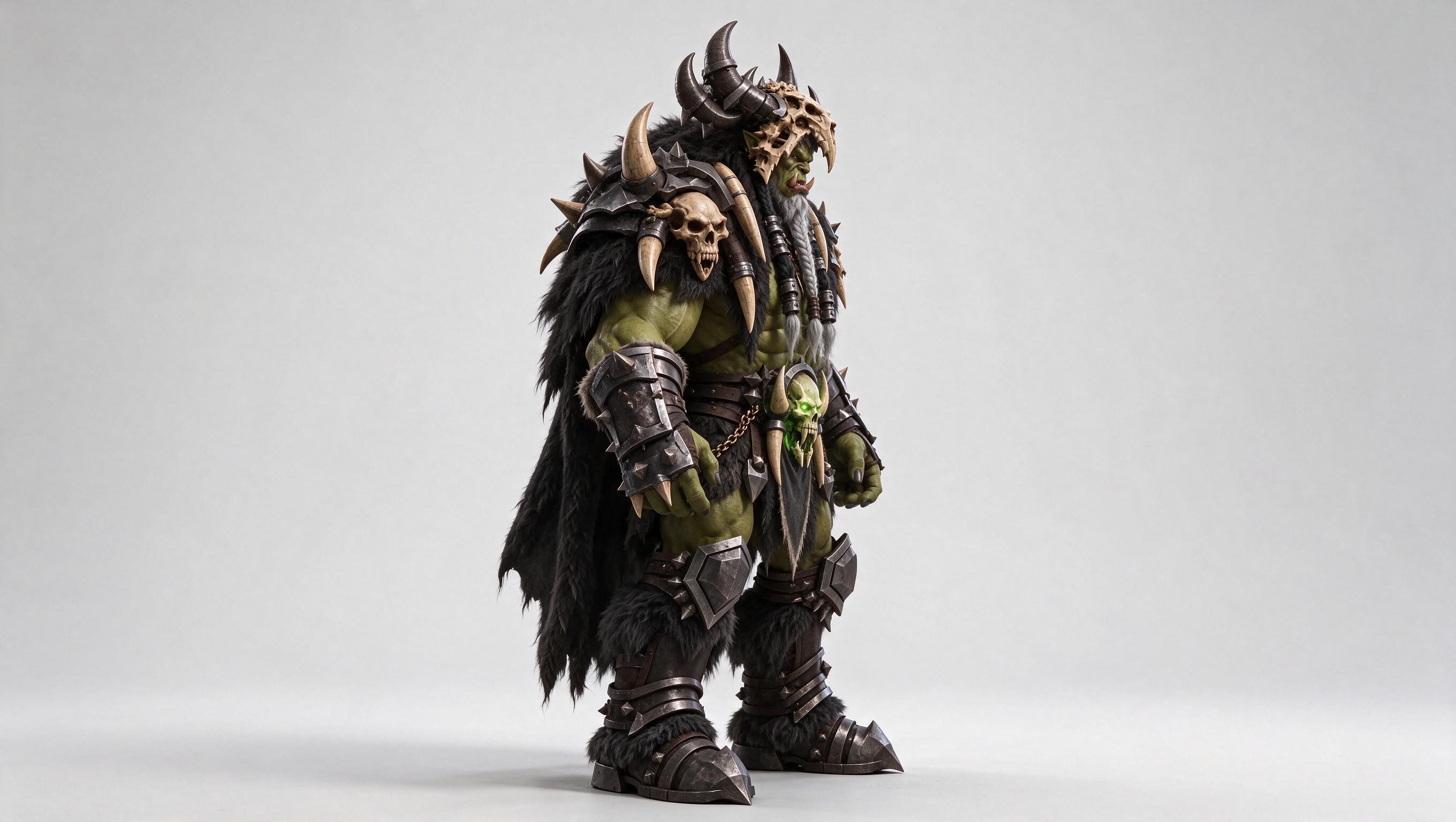
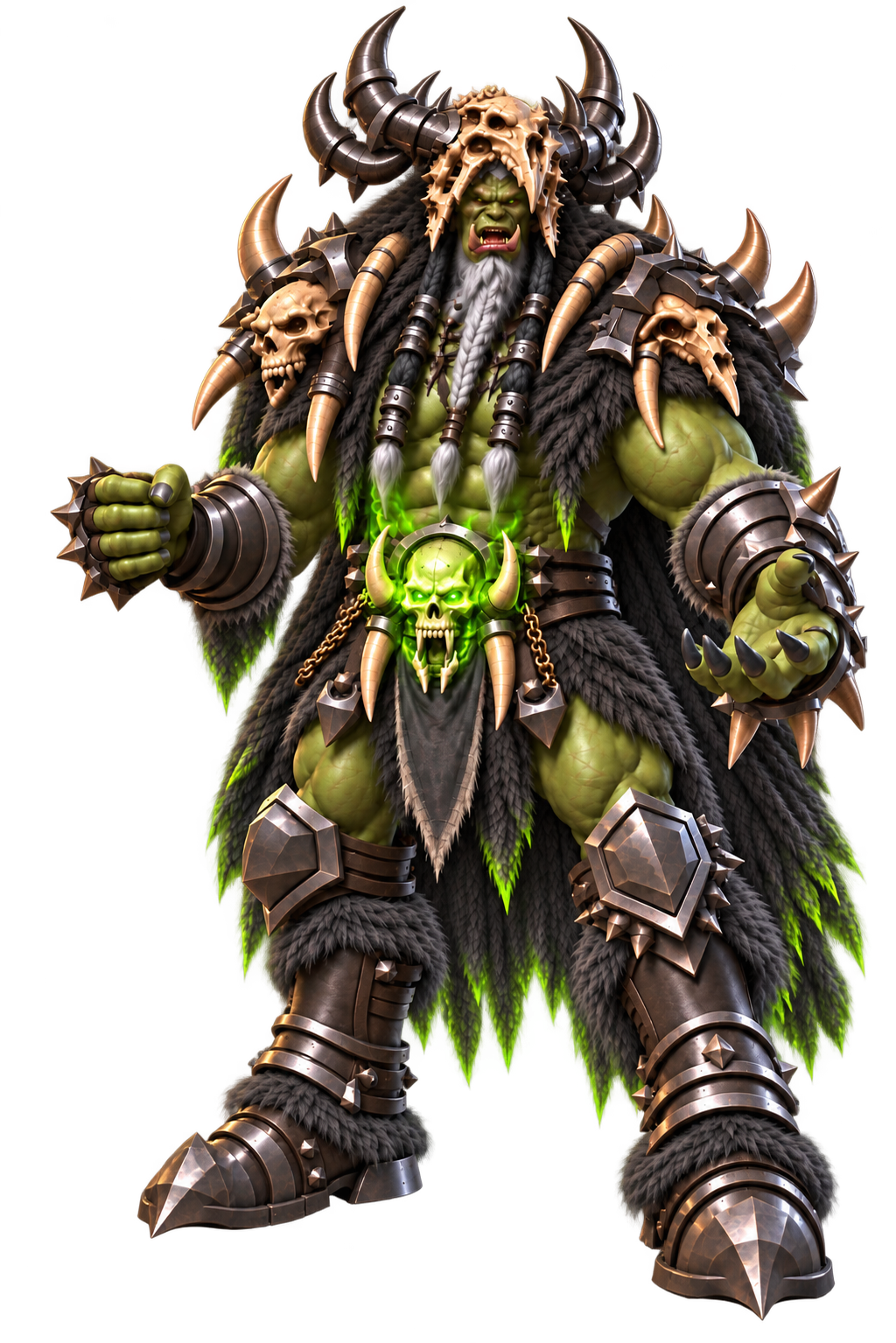
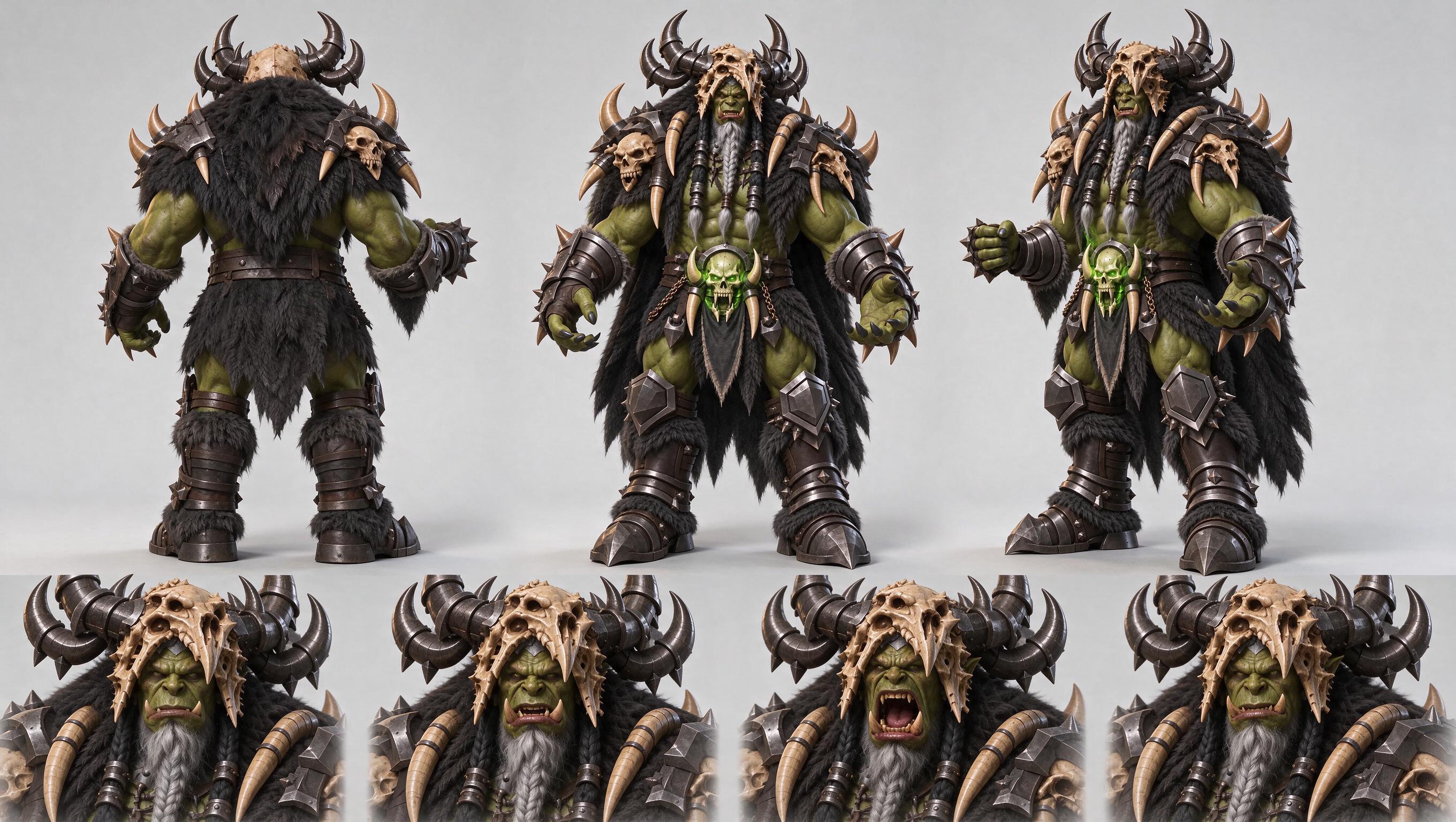
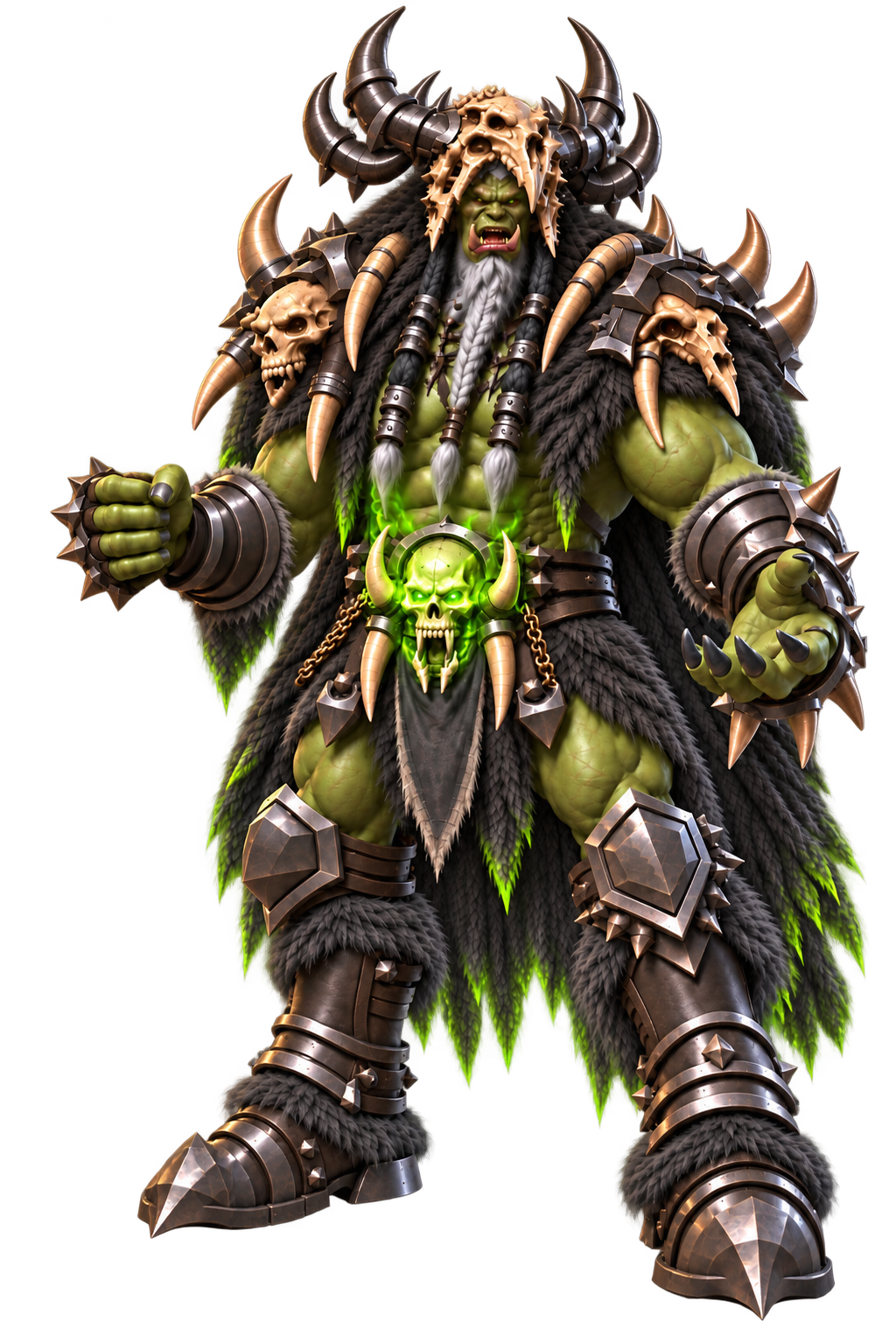
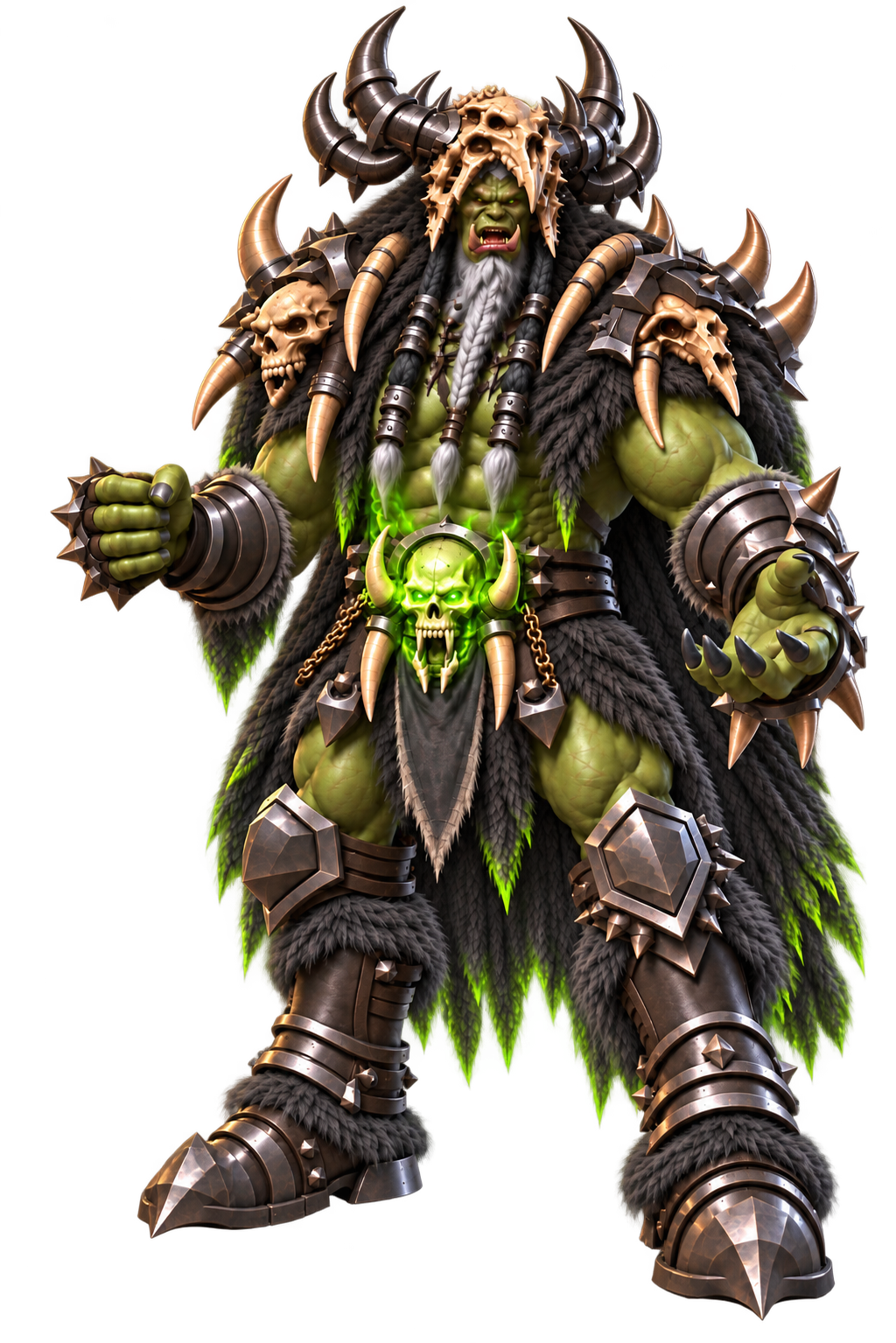
# ORC BOSS — HOLLYWOOD LIVE-ACTION CHARACTER REFERENCE Create ONE extraordinarily photorealistic, full-body cinematic character photograph of the ORC BOSS from the uploaded reference image. **THE MOST IMPORTANT REQUIREMENT: EXACTLY ONE CHARACTER, SHOWN IN A STRICT 90-DEGREE SIDE PROFILE.** This is NOT a character sheet, NOT a collage, NOT a turnaround, and NOT a three-quarter view. The uploaded original image is the PRIMARY AND ONLY character-design reference. Preserve the creature's recognizable identity, imposing physique, distinctive skull helmet, complex horn arrangement, long braided beard, heavy black fur, bone ornaments, armor, and glowing green skull-shaped belt ornament. The objective is to transform the illustrated fantasy character into a physically convincing living creature from a high-budget Hollywood dark fantasy feature film. ## 1. CAMERA ANGLE — ABSOLUTE SIDE PROFILE The camera is positioned EXACTLY 90 degrees to the orc's body, photographing him from his LEFT SIDE. The orc faces toward the RIGHT EDGE OF THE IMAGE. His entire body must be oriented sideways: - Head facing directly right. - Nose pointing horizontally to the right. - Both shoulders aligned along the same side-view axis. - Torso rotated a full 90 degrees away from the camera. - Hips facing right. - Knees and armored boots pointing right. - Arms relaxed naturally beside the body. The camera must remain perpendicular to the character. ONLY ONE SIDE OF THE FACE IS VISIBLE. Only the near eye should be clearly visible. The far eye must be hidden behind the natural anatomy of the skull. The nose, protruding tusks, lips, chin, and facial silhouette must form an unmistakable TRUE SIDE PROFILE. The far shoulder, arm, and leg may be partially occluded by the nearer side, as they naturally would be in an authentic side photograph. **DO NOT rotate the character's head toward the camera.** **DO NOT show both eyes.** **DO NOT use a three-quarter angle.** **DO NOT show the chest symmetrically from the front.** This must be a genuine anatomical 90-degree profile, photographed from head to toe. ## 2. CHARACTER IDENTITY — PRESERVE THE ORIGINAL DESIGN The orc is an enormous adult male fantasy warlord with an exceptionally powerful, heavyweight physique. He must look physically massive, with: - Extremely broad shoulders. - Thick muscular neck. - Huge chest and upper back. - Massive upper arms and forearms. - Powerful abdomen and torso. - Thick muscular thighs. - Heavy legs and enormous armored boots. Maintain a believable center of gravity and realistic anatomical weight. The orc should look like a creature weighing several hundred kilograms, capable of physically overpowering a human. Do not make him slender, athletic like an ordinary human, or disproportionately cartoonish. He must retain the imposing silhouette of the ORIGINAL reference. ## 3. HEAD, FACE AND SKIN — LIVING CREATURE REALISM Preserve the original orc's recognizable facial anatomy: Deep olive-green skin, extremely heavy brow ridge, broad flattened nose, powerful protruding jaw, prominent lower tusks, deep-set threatening eyes, aged facial features, and a thick gray-white beard. The skin must appear biologically real rather than digitally sculpted. Include: - Clearly visible natural pores. - Deep and irregular facial wrinkles. - Subtle scars and healed abrasions. - Uneven skin pigmentation. - Slight variations between olive, dark green, gray-green, and weathered earthy tones. - Natural skin oil and realistic roughness. - Realistic subsurface light scattering. - Anatomically plausible facial folds. - Natural transitions between stretched and compressed skin. - Realistic lips, gums, teeth, and tusks. - Tiny imperfections around the nose, cheeks, ears, and neck. His face must suggest a real living creature with decades of combat experience. The visible eye should be anatomically convincing, with realistic moisture, a clearly defined iris, believable reflections, and natural surrounding eyelids. No giant cartoon eyes. No exaggerated facial expression. His expression is NEUTRAL BUT INTIMIDATING, with a closed or slightly parted mouth and a stern forward gaze. ## 4. SKULL HELMET AND HORNS — CRITICAL IDENTITY ELEMENT Reproduce the distinctive skull-shaped helmet from the original reference. The helmet is constructed from a large, weathered beige animal skull with irregular bone surfaces, holes, cavities, ridges, cracks, and naturally worn edges. Multiple enormous curved dark metallic horns extend around the upper helmet, preserving the original complex arrangement and recognizable silhouette. The horns must have: - Natural curvature. - Realistic thickness and weight. - Subtle asymmetry. - Physically believable construction and attachment. - Scratches, oxidation, and surface wear. - Realistic metallic highlights. The beige skull must look like genuine aged bone, NOT painted plastic. From the strict side profile, show how the skull helmet extends forward over the orc's forehead and how the large horns project upward and backward. Do not redesign the helmet. Do not replace it with a generic Viking helmet. Do not simplify the complex horn structure. All horns must remain entirely inside the image. ## 5. HAIR, BRAIDED BEARD AND BLACK FUR The orc has long dark hair and a thick gray-white beard arranged into several heavy braids, as shown in the original reference. Preserve the characteristic braided sections, metal rings, and overall length. Every braid must have realistic weight, believable individual hair strands, irregular thickness, and natural gravitational behavior. The huge black fur mantle covering the orc's shoulders and back must look like genuine thick animal fur. Individual strands should be visible, with irregular lengths, naturally matted sections, subtle dust, and organic variation. The fur must hang heavily over the shoulders and down the back. The silhouette of the fur mantle is essential to the character's identity. Do not turn the fur into a smooth digital surface, feather-like material, or an ordinary fabric cape. ## 6. ARMOR, BONES AND COSTUME MATERIALS Preserve all major armor features from the original reference: Massive dark metal shoulder armor, attached animal skulls, curved ivory tusks, large armored forearm guards with spikes, thick leather belts, chains, rugged lower-body garments, heavy metal knee protection, fur elements, and enormous reinforced boots. Materials must be completely believable: **METAL:** heavy forged steel, darkened iron, scratches, dents, oxidation, realistic machining and hammer marks, subtle metallic reflections. **BONE:** porous aged material with organic discoloration, chipped edges, natural cracks, and realistic irregularity. **LEATHER:** thick worn leather with visible grain, creases, seams, scratches, and natural tension. **FUR:** dense organic fibers with individually visible strands and realistic shadows. **FABRIC:** coarse woven fibers, natural folds, weathering, and realistic material thickness. All objects must have physically believable attachment points, weight, and contact with the body. The armor must look functional and physically constructed, not sculpted as part of a video-game model. ## 7. GREEN SKULL BELT ORNAMENT Preserve the large horned skull ornament at the center of the orc's belt. This is one of the defining elements of the original character. The skull has a restrained supernatural green glow emanating from its eyes and inner cavities. The lighting effect must be realistic and localized. Nearby metal, leather, skin, and bone should receive a subtle green reflection. Do not cover the whole body in neon light. Do not generate floating magical particles, explosions, smoke, or lightning. The green belt ornament must remain clearly recognizable even from the side. ## 8. HOLLYWOOD CINEMATIC HYPERREALISM Visual quality: Hollywood Cinematic Hyperrealism. Live-Action Feature Film. Ultra-Realistic Cinematic Photography. ARRI Alexa 35 visual characteristics. Cooke S4/i cinema lens aesthetics. Professional high-budget creature photography. Kodak Vision3-inspired organic color grading. The image should look like a professional photograph of a physically real creature standing on a major Hollywood production stage. Imagine an extraordinary combination of realistic creature prosthetics, complex practical armor, natural organic materials, and seamless invisible cinematic visual effects. The viewer should perceive a living, breathing, physically present orc rather than a computer-generated fantasy character. Extremely high detail without artificial sharpness. Realistic optical behavior, organic tonal transitions, natural shadows, subtle film grain, and physically accurate material response. ## 9. STUDIO ENVIRONMENT Use a clean, uniform LIGHT-GRAY studio background. Background color: #E5E5E5. The studio floor must match the background in tone. A soft natural contact shadow must be visible beneath the armored boots. Lighting: - Large soft neutral key light. - Gentle fill light. - Subtle separation lighting. - Natural shadow falloff. - Neutral white balance. - No theatrical colored lighting. All armor, fur, skin, and bone details must be visible without excessive contrast or blown highlights. No environment, mountains, castles, portals, battlefield, smoke, fog, flames, or decorative elements. ## 10. PHOTOGRAPHIC COMPOSITION Produce ONE SINGLE FULL-BODY VERTICAL PHOTOGRAPH. Aspect ratio: 2:3. The entire orc must be visible from the HIGHEST TIP OF THE HELMET HORNS to the LOWEST POINT OF HIS BOOTS. Place the orc approximately in the center of the frame, with sufficient empty space around his silhouette. Camera positioned at approximately chest height. Use natural telephoto studio portrait perspective, approximately 70–85 mm full-frame equivalent, without wide-angle distortion. Keep the entire character sharp and well-defined. Avoid extreme depth-of-field blur. The pose must be a natural, neutral standing position appropriate for a professional movie creature reference. No walking, attacking, roaring, or dramatic battle movement. No weapons, axes, staffs, or additional props. ## 11. STRICT NEGATIVE REQUIREMENTS No illustration. No concept art. No anime. No cartoon. No video-game character. No Unreal Engine aesthetic. No polished 3D render. No plastic skin. No waxy skin. No smooth computer-generated fur. No glossy fantasy toy materials. No exaggerated monster proportions. No generic orc redesign. No different face. No replacement helmet. No missing horns. No missing beard braids. No simplified armor. No additional accessories. No artificial green lighting across the entire body. No front view. No three-quarter view. No character sheet. No multiple figures. No facial-expression grid. No collage. No text, captions, labels, logos, or watermarks. ## FINAL ABSOLUTE REQUIREMENTS Generate EXACTLY ONE orc. Show his FULL BODY. Show him in a STRICT 90-DEGREE LEFT-SIDE PROFILE, FACING RIGHT. Preserve his ORIGINAL identity, enormous physique, horned skull helmet, long braided beard, dark fur mantle, skull ornaments, and massive armor. Use a UNIFORM NEUTRAL LIGHT-GRAY BACKGROUND. Make him look like a PHYSICALLY REAL CREATURE from a high-budget Hollywood live-action dark fantasy film. **IDENTITY ACCURACY AND PHOTOGRAPHIC REALISM ARE MORE IMPORTANT THAN ARTISTIC INTERPRETATION.**

Бесплатный старт · Генерация видео и картинок с ИИ за секунды
More from this creator
More Seedream 5.5 images
См. все →