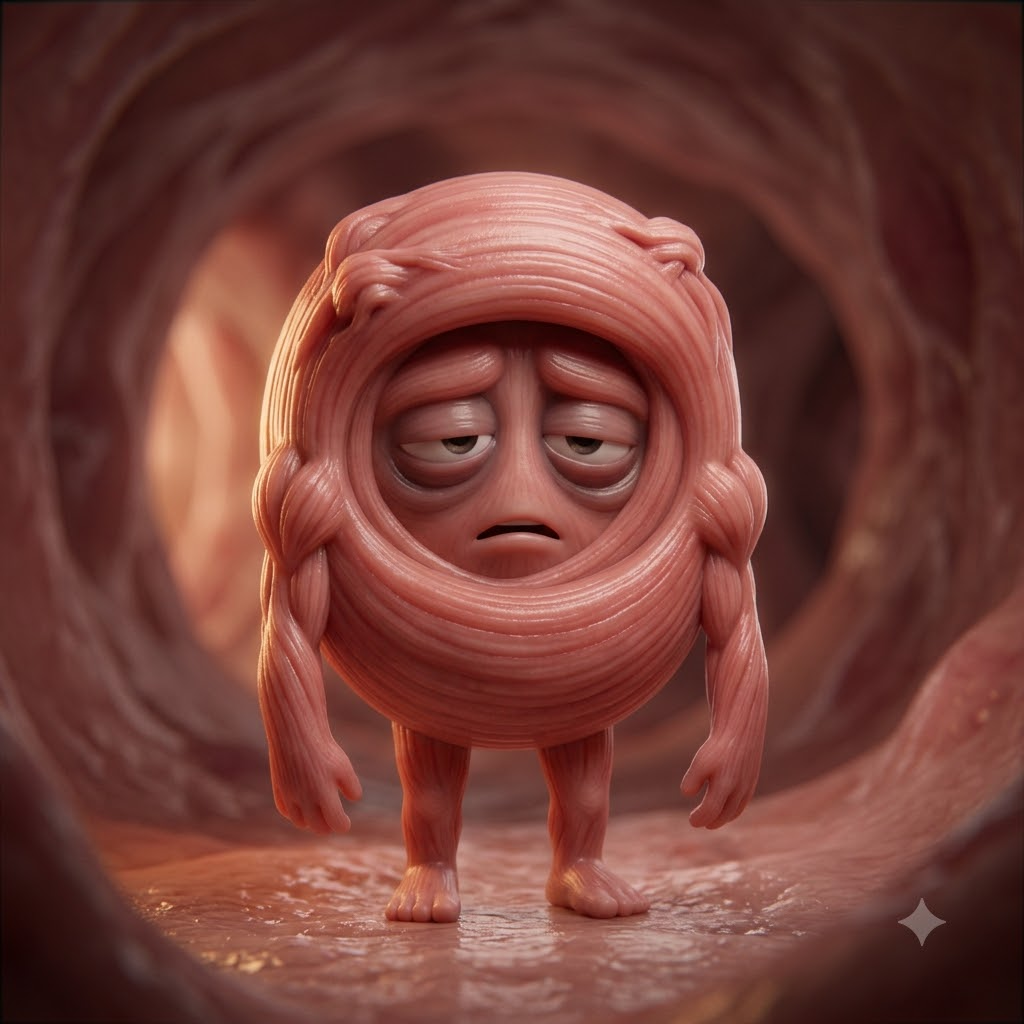


Art style: 3D Pixar. Full-length view, the entire figure visible from head to feet, standing upright, centered — a tiny anthropomorphized orbicularis oculi muscle, the ring-shaped muscle that circles the eye. Its body is a small oval loop of soft pinkish-red striated muscle fibers, glossy and slightly translucent, with faint parallel striations running along its curved bands. It has two weary little eyes with heavy drooping lids and dark under-eye shadows, a small downturned mouth, and short stubby arms and legs of the same fibrous tissue ending in tiny bare rounded feet planted flat on the ground. Its whole frame looks overworked, hunched and tense — shoulders clenched high, fibers knotted tight from years of squinting. Exhausted, slumped posture, sighing expression. Standing in a dim, softly lit anatomical corridor, moist and pinkish, blurred behind it. No text. ━━━━━━━━━━━━━━━━━━━━━━━━━━━━━━━━━━━━━━ FINAL STYLE ENFORCEMENT (this is the authoritative rendering directive — it overrides any style wording elsewhere in the prompt): Render this image in the following art style: Pixar-style 3D computer animation (Pixar / Disney feature-film look) — fully volumetric 3D rendering with rounded dimensional forms, soft subsurface-scattering skin, physically based materials, soft global illumination, warm cinematic key light, gentle depth of field, vibrant family-friendly colours. CRITICAL: EVERY element — characters, foliage, trees, animals, water, sky, props and the entire environment — must be rendered as polished 3D CGI with real depth and form. This is NOT flat 2D illustration, NOT a watercolour or storybook painting, NOT cel-shaded anime. Every surface, skin, fabric, material, and environmental element must be rendered in this idiom.
Бесплатный старт · Генерация видео и картинок с ИИ за секунды